If you work in a tannery, you've been hearing about LWG more and more often over the past few years — in brand contracts, buyer emails, conversations at Lineapelle. But what does it actually mean? Who gets it? And does it really make a difference, or is it just another certification that costs money and changes little?
Here's how the Leather Working Group works, what the audit evaluates, and what it means in practice to have it — or not.
What Is the Leather Working Group?
The Leather Working Group (LWG) is an international non-profit organization founded in 2005 by a group of brands — including Nike, Marks & Spencer, and other global retailers — with a specific goal: create a shared standard for assessing the environmental and operational practices of tanneries.
The idea was straightforward. Instead of every brand sending its own auditor to every tannery worldwide (with different costs and criteria each time), a single standard and a shared audit would be created. Tanneries that pass receive a certification recognized by all LWG member brands.
Today, LWG counts hundreds of member brands and thousands of certified tanneries globally. It is no longer a niche standard — it has become the de facto benchmark for anyone supplying leather to major international retailers.
How the LWG Audit Works
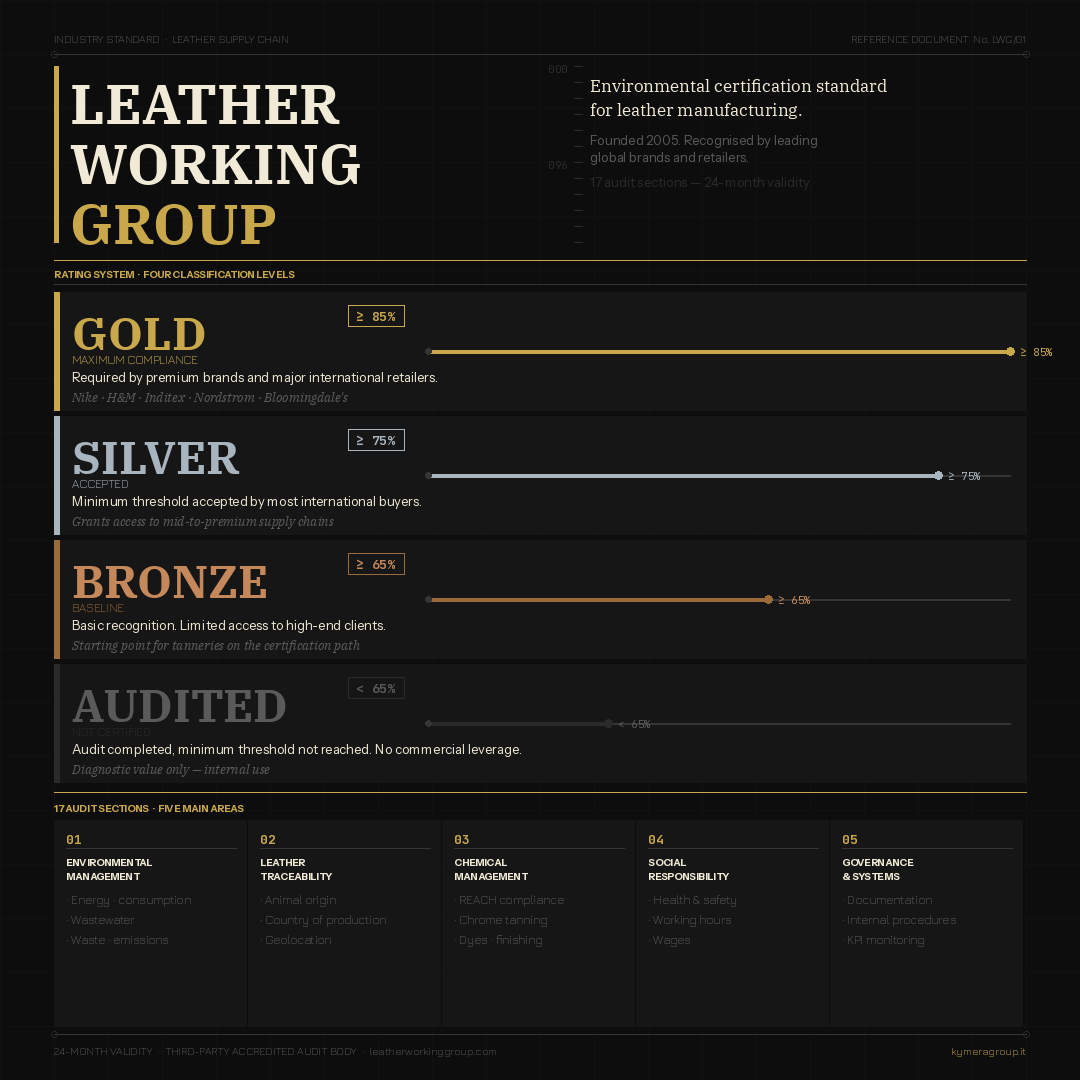
The LWG audit evaluates a tannery across 17 sections organized into five main areas:
1. Environmental Management
Energy consumption, emissions, waste management, wastewater treatment. This is the heaviest section of the audit — tanneries are evaluated on how they measure and reduce their environmental impact, not just what they claim.
2. Leather Traceability
Where does the raw hide come from? The animal's origin, country of production, supply chain. With the EUDR debate still open (the EU proposal to exclude leather from the anti-deforestation regulation was published in May 2026, but the issue remains unresolved), traceability has become one of the most sensitive points of the audit.
3. Chemical Management
Which substances are used in the tanning process? Are they compliant with REACH restrictions and brand restricted substance lists? This covers chrome tanning, dyeing, and finishing.
4. Social Responsibility
Working conditions, health and safety, working hours, wages. Increasingly prominent in requirements from European brands.
5. Governance and Management Systems
How the tannery documents and monitors all of the above. Doing it right isn't enough — you have to prove it with data, records, and procedures.
The audit is conducted by certification bodies accredited by LWG Assurance Services. It is not self-certification: a third-party auditor is required.
The Rating Levels
At the end of the audit, the tannery receives one of four ratings:
| Rating | Minimum Score | What it means |
|---|---|---|
| Gold | ≥ 85% | Maximum compliance — required by premium brands and major retailers. |
| Silver | ≥ 75% | The minimum threshold accepted by most international buyers. |
| Bronze | ≥ 65% | Baseline recognition — limited access to high-end clients. |
| Audited | < 65% | Audit completed, threshold not reached. No commercial leverage. |
"Audited" means the audit was completed but the score didn't reach even the Bronze threshold. The tannery knows where it stands, but cannot use the certification as a commercial lever.
Certification is valid for 24 months for manufacturing tanneries, after which it must be renewed. For semi-processed material traders, validity is 12 months.
Most brands that require LWG accept Silver as the minimum threshold. Gold is required by the most demanding players or for premium product supply.
Who Requires LWG Certification Today
This is the point that matters most operationally.
LWG is not required by law. But in the market, it already functions as a de facto prerequisite for a growing share of international buyers. Brands that require or prefer LWG-certified suppliers include names like H&M, Inditex, Nike, Nordstrom, Bloomingdale's, and many other European and North American retailers.
In practice: if a tannery wants to supply major fashion or footwear brands, LWG is increasingly a prerequisite — not in the first email, but when the time comes to qualify as an approved supplier.
For tanneries working primarily with local clients or independent buyers, the pressure is still relatively low. But the direction is clear, and the delay in certification tends to become a problem at the worst possible moment.
What Does the LWG Audit Cost?
The cost varies based on the tannery's size and the chosen certification body. As a rough benchmark:
- Audit for a mid-sized tannery: between €3,000 and €8,000 for the first cycle (including pre-audit, audit, and documentation management)
- On top of this, there is the internal preparation cost: data collection, procedure updates, and any external consulting
It's not a trivial figure, but it needs to be weighed against the value of the contracts the certification can unlock or protect.
What You Need to Prepare
The most demanding phase is not the audit itself — it's the preparation. Tanneries starting from scratch often find they need to:
- Implement measurement systems for energy and water consumption
- Create traceability records for incoming hides
- Update technical data sheets for all chemical inputs
- Document health and safety procedures that already exist but have never been formalized
In many cases, the practices are already in place — what's missing is the documentation. And documentation is exactly what the auditor looks at.
FAQ
Does LWG certification apply to vegetable-tanned leather?
Yes. The LWG audit applies to all tanning methods — vegetable, chrome, glutaraldehyde. The criteria are adapted to the tannery's specific process.
Can a small tannery obtain it?
Yes. There are no minimum size requirements. Artisan tanneries can get certified, although the preparation process requires investment proportional to their resources.
Does LWG cover semi-processed hides (wet blue, crust)?
Yes. There is a specific category for traders and processors of semi-processed materials, with a shorter certification validity of 12 months instead of 24.
If I don't have it, will I lose all my clients?
It depends on your current client base. If you supply international fashion or footwear brands, the risk is real in the medium term. If you work with local markets or independent niches, today's pressure is lower — but the situation is changing fast.
Bottom Line
LWG is not a passing trend. It has become the global reference standard for environmental compliance in the leather supply chain, and the pressure from brands is increasing, not decreasing.
If you want to understand where your tannery stands relative to LWG requirements, or which machinery and process investments can help you improve your score in the environmental sections, I'm happy to talk it through — no commitment required.
If you want to understand where your tannery stands relative to LWG requirements, or which machinery and process investments can help you improve your score in the environmental sections, I'm happy to talk it through — no commitment required.
Sources: Leather Working Group — Certification · LWG Leather Manufacturer Standard